Italian Army Eagle
A monumental Italian bronze eagle with outstretched wings, perched atop an obelisk forming the letters “EIA” and along the pedestal base the Latin motto “MAGIS MAGIS QUE”.

Showing 13–24 of 53 results
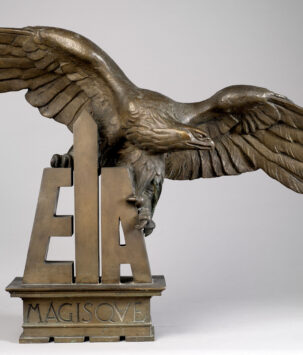
A monumental Italian bronze eagle with outstretched wings, perched atop an obelisk forming the letters “EIA” and along the pedestal base the Latin motto “MAGIS MAGIS QUE”.
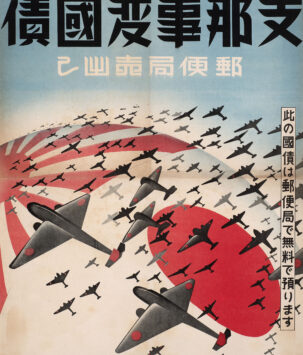
A grand array of military aircraft soaring above the national and war flags of Japan highlights the empire’s boundless and unrelenting military might. Japanese propaganda poster calling for the purchase of war bonds.
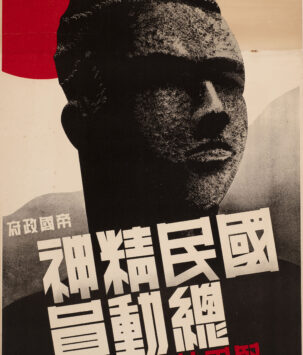
A stoic figure is depicted with stone-like ruggedness illuminated by the light of hope. Japanese poster calling for the spiritual mobilization of its populace to steel themselves for the upcoming struggle. The text and imagery alludes to the stoic character of the Japanese people and calls for them to exercise this iron-willed determination in the face of adversity.
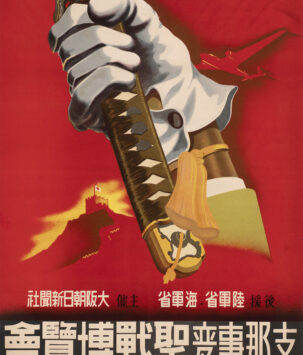
Japanese poster promoting an exposition in support of the Second Sino-Japanese War. A katana is raised triumphantly above the backdrop of the Great Wall of China flying a Japanese flag. Signifies Japanese primacy over China while also extolling Japan’s martial heritage. Following the Japanese invasion of Manchuria in 1931, easterly portions of the Great Wall were indeed controlled by the occupying Japanese forces up until their surrender in 1945.
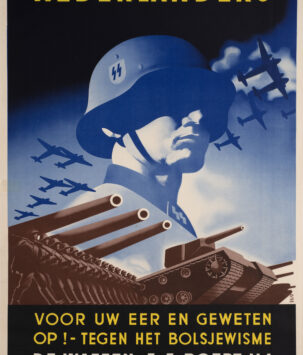
A potent Waffen-SS recruitment poster from the occupied Netherlands. A legion of stormtroopers march in unison surmounted by an array of artillery guns and lead by a platoon of tanks, all of which comprise an earthy foreground and gives the poster its sturdy visual foundation. The profile of a stoic, faceless stormtrooper hovers assertively above his comrades in a darkened sky lined with bombers. One of the most iconic pieces of modern propaganda.
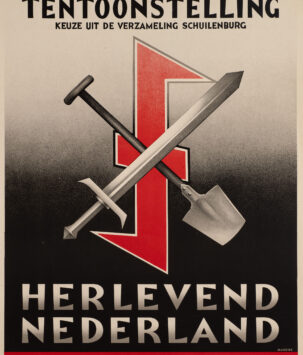
Dutch poster during the German occupation promoting an exhibition about the economic and cultural revival of the Netherlands. A Wolfsangel, the symbol of Dutch National Socialism, is displayed prominently in the middle. A sword and spade, symbolizing the dual pillars of National Socialism, surmount the Wolfsangel: The sword embodies the iron will of the ‘nation’ and its Volk, while the spade represents the ‘social’ commitment to self-improvement, charity, and compassion for fellow citizens in the pursuit of economic autarky.
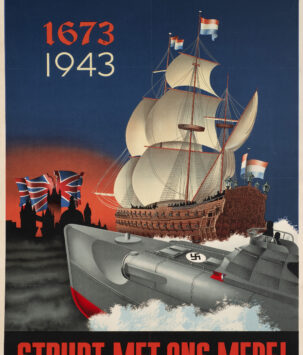
A poster from the German-occupied Netherlands juxtaposing an antiquated Dutch three-decker with a modern German U-boat with the Germanic allies setting sail for London. The Germans sought to win over the Dutch by reigniting feelings of the historical Anglo-Dutch naval rivalry. The two preeminent seafaring nations of western Europe can trace their enmity back to the year 1673 as referenced on the poster, during which the Third Anglo-Dutch War took place. It was the last successful invasion of the British isles by a foreign power.
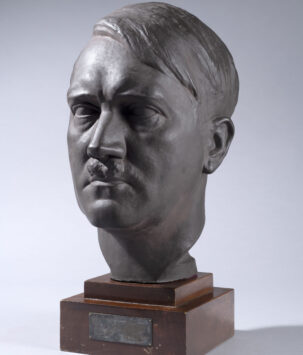
A larger-than-life ceramic sculpture of Adolf Hitler manufactured by Allach Porcelain and designed by Ottmar Obermaier. Possesses an exceptional likeness to the Führer and emanates a certain mystical quality.
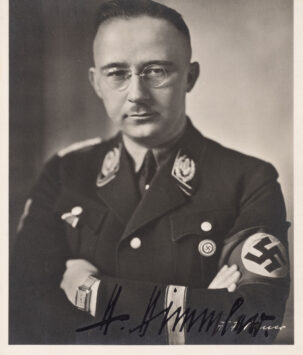
A signed portrait of Reichsführer-SS Heinrich Himmler. As head of the secretive paramilitary organization, the Schutzstaffel (SS), autographs of Himmler are considered exceptionally rare compared to that of more high-profile figures such as Hitler, Göring or other prominent military figures. As overseer of the many concentration camps and the Einsatzgruppen mobile death squads, he served as one of the main architects of the Holocaust. Himmler was guided by his interests in Germanic paganism, mysticism and the occult which he tied to his racialist philosophy in order to create a new, Germanic religion to replace christianity. Such esoteric rituals and symbolisms were incorporated into the SS, with the logo of the SS itself being comprised of two ancient Germanic sig (victory) runes.
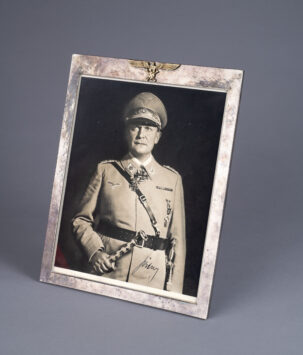
Signed photograph of Hermann Göring contained within a period presentation frame. Depicts the Reichsmarschall half-length in full dress uniform c. 1940, his marshall’s baton and awards all readily visible. Presumed to be the first official photograph commemorating his 1940 promotion to ‘Reichsmarschall des Grossdeutschen Reiches’. The frame is adorned with an eagle clutching two crossed marshall’s batons and a swastika, a motif often used by the Reichsmarschall. Excellent condition.
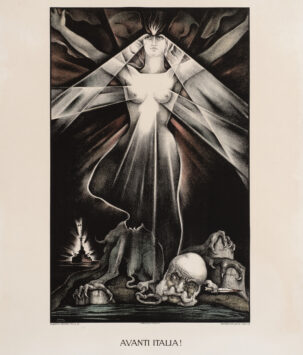
Irredentist lithograph by Alberto Martini depicting an ethereal personification of Italy as she stands triumphantly over the Austro-Hungarian Empire. Austria-Hungary is represented by a beastly reptilian interpretation of Emperor Franz-Joseph,, seen claiming rightfully Italian lands for himself.
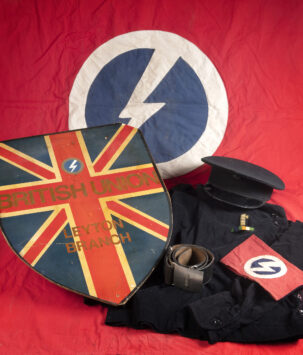
A collection of artifacts from the British Union of Fascists (BUF) including a flag, Leyton branch headquarters plaque, paramilitary peaked cap from the Fascist Defence Force and an officer’s tunic paired with a BUF armband and belt.
Active male members of the BUF wore the famous black shirt as their uniform, modelled on Sir Oswald Mosley’s fencing tunic. The black shirt was stated to be worn because the color black best expressed the iron determination of Fascism in the face of red anarchy. By eliminating distinctions of dress, it also contributed to the breaking down of class barriers within the movement. The tunics were worn for ideological as well as practical reasons, as in street fights the tunic offered little for an opponent to get a grip on. They were worn until the banning of political uniforms under the Public Order Act 1936.